Saturday, 26 January 2019

New Year, New Thoughts

Happy New Year everyone

From this January I’m hopefully going to bring you more content on the delights of social eating and entertaining, as well as insights into wellness and perhaps some guest reads as well.

January started for me, like many people, in the sad exercise of taking down the seasons decorations.  The only remnant being the golden glass Christmas tree whose home is pride of place on our bookshelves, silently celebrating the holiday all year round.

It’s not the only ode to the changing years, there is also a glass monkey, cockerel and a dragon who nod to the celebratory Chinese new year and always makes me smile.

January also brought different foods, a break from the rich Christmas and New Year provisions, thick vegetable casseroles (with Turmeric and root vegetables) are this year’s tour de force so far (recipe to follow naturally) and, taking on a tradition from my Welsh relatives, so far added to with fresh ingredients from our winter allotment.  Soon to be added to for a third time with winter greens.

I normally cook for more people than I need to and, especially in colder weather and as an excuse to check in on less mobile neighbours, I take a bowl or three to simply say hi and have a chat.  I’ve found it’s always a great idea to knock on the door and offer new year wishes simply to keep in touch.

I hope January is good to all of you and 2019 be an exciting adventure for everyone.

Sunday, 4 November 2018

Sunshine and rainy days

Although its hard at times, we really do need to remember our paths can be frought and that many things, emotion, people or simply our daily lives, can interfere with our goals.

This is simply the way of it, accept it, and then keep walking.  You will always find your path so long as you remember your destination.

Friday, 30 June 2017

The last day of June

An amazing show of colour today at the allotments.

The beauty of mid-summer really shows through.

Beautiful colours makes us all smile.  So whether its in your own garden, a friend's or an inspiring park or your own allotment, enjoy the summer and smile.

Wednesday, 10 May 2017

Eurovision - friends and food

Eurovision, you either love it or hate it, but you can't ignore it.   To some its the social event of the year and others, well, maybe not so much.


Beyond the show and the singing however, there is the social aspect which gets ignored by both its critics and by the media generally. It is definitely a great example of bringing people, friends, family and old acquaintances, together.

Unlike seasonal holidays, you are under no obligation to invite family but, of course you do. The pressure is off to make formal preparations for food or drink and, to many a group of friends, its an excuse to shout at the TV without the feeling self conscious. Actually, an all round good bit of fun, and also no obligation to watch the show itself but to simply get competitive with the scoring at the end! A little more seriously, the event does carry with it a real feel good air, especially as it brings friends together that may have not seen one another for a number of weeks or months.

Food is informal and for the most part, can be a mixture of platters and bowls. More substantial meals are probably an inconvenience for the most part, who wants to prepare dinner when you may have twenty people squeezed into a one or two bedroom flat or apartment?

If you have a handy deli or grocers that can prepare these for you, even better. For those of you who would like to prepare a few things of their own, I've laid out below some suggestions for a number of titbits, but if you run out of time, don't stress, crisps, dips and pizza is normally just a phone call away.

Dips which can be prepared days in advance

These are great to have on standby and very straight forward to make and these three dips which are great to make and full of flavour. Using three types of bean/pulse.

Use a large tin of chickpeas and butterbeans for ease rather than all that soaking overnight.

For roasting: One bulb of garlic, three large red peppers, a large white onion and some good olive oil.

To a medium sized baking tray add:
• the garlic cloves, but don't peel them
• the peppers (whole but de-stalked)
• one onion, peeled and quartered
• olive oil to coat the above
• a couple of pinches of salt Bake in medium to hot oven (190c) for 25-30 minutes.

For the dips:

• One tin (220 grams) each of chickpeas and butterbeans
• 300 grams of cooked broad beans
• 20 grams mint
• 20 grams parsley
• three dessert spoons of honey
• one teaspoon of ground cumin
• the juice and zest of one medium lemon
• 50 grams of freshly grated parmesan

For the chickpea dip:

In a food processor add the drained chickpeas, the garlic (which should easily come out of their skins), onion, parsley and honey and process until smooth.

For the butterbean dip:

Again, in the food processor, add the drained butterbeans, the roasted peppers (after putting them in a plastic bag to cool, the skins should easily come away), salt to taste and the cumin. Process until smooth.

For the broad bean dip:

After first shelling the beans and using a potato masher, add the mint and parmesan. Add the lemon juice and zest.

Something to munch on:

Chorizo, always a good standby and always very quick to prepare. Slicing it up into generous bite size pieces with some additional olive oil and putting a little extra chilli and/or garlic onto a baking tray, adding halved mid-sized mushrooms to soak up a little of that oil and putting these into a moderate oven (say 170-180c) for 15-20 minutes is a really good and simple way to impress.

Once you've taken these out of the oven and whilst still hot, drizzle with a tablespoon of honey and combine. The sweet, hot, spicy combination is addictive.

House roasted Almonds (or cashews, or walnuts or a mixture of all three)

With a little oil, add 250 grams of blanched nuts to a baking tray. Again, in a moderate oven for 15-20 minutes. Separately, in a bowl, add two heaped teaspoons of smoked sweet paprika, two generous teaspoons of dried thyme or chopped dried rosemary and an equal amount of sea salt. Taking the nuts out of the oven add these to the spice mixture whilst still hot and combine thoroughly.

House olive mix

In a shallow pan, add two tablespoons of olive oil and a large crushed clove of garlic whilst the oil is still warming through. Add a half teaspoon of turmeric and a teaspoon of cumin seeds. As the garlic is just starting to golden, take off the heat and add the zest and juice of a large lemon (or of two limes).

Separately, in a large bowl, thinly slice half a large red onion and separate the crescents. Add your choice of olives (250 grams) and add the spice mixture. Mix and allow to cool.

Additions could in include finely sliced chillies and/or sweet peppers. Just for a little crunch.

For those of you who have a little more time as these are quite fiddly to make:

Simple Asparagus Rolls

Take one large day old, loaf of white bread, ideally leave in a plastic bag overnight on the side - carve the crusts off and then thickly slice lengthways, You should have five, large, thick slices, butter these on one side.

Take some Parma ham and lay these on each slice of bread, you will need four, possibly six slices of ham for each slice bread, depending on the size of your loaf. Take your asparagus which has been blanched and slice lengthways. Place these end to end and side by side from about an inch from the long edge of each slice of bread. Roll the lengthways and fasten with cocktail sticks.

Place on a baking tray and brush with olive oil and cook until brown - this should take no more than 20 minutes. Allow to cool and cut into appropriate lengths.

Monday, 8 May 2017

Social Sunshine

"Fresh air, brilliant company, a picnic and a show!"

We've all watched groups of friends in the park before now, from simply gossiping in the sunshine, having a game of old fashioned rounders (soft ball to my US readers) to having a full blown sports day.  But if you stay and watch the comings and goings in our cities and towns, you'll see other groups of friends doing other activities. 


Entertaining in public places
St Paul's Church yard
City of London
I've seen a trio of musicians on Hampstead Heath practicing their latest set and a pair of actors practicing their lines in Soho Square.  The musicians obviously needed practice but with the hoots of encouragement from the sunbathers, they soon hit their stride and their confidence grew in the 40 minutes or so I was watching.   The actors practicing their lines were so focussed on the moment, they weren't aware of the number of people who simply stopped, sat and enjoyed their lunches and before you knew it, they had finished to a very loud round of applause.  Blushes aside, they left very pleased with themselves.  I hope they got the parts they were working towards.

On a weekday lunch time, a group of friends were enjoying the sunshine in the little park next to St Paul's Cathedral in the City of London.  One of them had a Spanish guitar and the other two were just singing descant.  It was an enchanting moment and the business people having coffee or wine in the nearby establishments came away from their bars and were completely enraptured.

When I was visiting New York and Barcelona in the 1990s, the parks, and the beaches for that matter, were used for a lot of different purposes.  Impromptu, what we would call today "pop-up", performances were, and still are, common. 

I've seen a makeshift stage made out of a tent and some brightly covered shawls in Central Park with a group of actors practicing a script that was terrible, but they were having fun and they had brought along friends and family to be their audience.  The show still attracted dozens of strangers, some would stay a few minutes and others (myself included) watched for a couple of hours.

Barcelona in the mid-90s was amazing, it was vibrant and edgy whilst still full of traditions.  One of the relatively new attractions were its beaches.  Before Barcelona had hosted the Olympics, the beaches were simply commercial areas and so with this new facility on their doorstep the locals and the tourists alike, used them to their full potential.  On one visit I watched and listened for over an hour to a group of opera students.  I asked my friend why they were performing on the beach and she laughed, "they are practicing for their exams!" and then proceeded to take me for a walk to show off other's doing the same thing.  The term for their exams were coming to a head and there were a number of groups and individuals practicing different forms of music along the beach in front of friends, family and strangers alike.

So with a little forethought, our amazing outdoor spaces can be so much more.  Lets embrace it, whether its coffee with friends, chatting and sorting out the world or perhaps simply talking about our latest exploits and adventures, there's nothing like a little outside chat and giggle!

So the idea is this, if you're a musician, actor, poet, writer, what's to stop you arranging a picnic with a group of friends one Saturday afternoon to practice a performance, read your latest verse or sing your practice piece for your next audition and have some fun too.   Maybe connecting friends that haven't met before?  And if you live in a flat that doesn't have a garden and is too small to entertain, then a park or the grounds of nearby stately home or a beach surely would be the next best thing?  Probably not so convenient in the Winter, but on a dry and ice cold Winter's morning, with a backdrop of a city or pocket park, a few friends gathering to help practice lines over donuts and coffee or read through a script on the roof or a balcony of your office building in a lunch hour, the possibilities are endless.  It could simply be another way to connect to work colleagues or neighbours and have a break from the day to day chores we all need to do.  Isn't it wonderful how entertaining reveals itself in so many different forms.

Angela, a good friend of mine who was a make-up artist turned puppeteer took my suggestion and ran with it a few Summers ago.  She invited a group of friends and friends of friends and neighbours, as she wanted to practice a mini-show she was designing for an art festival in the South of France.  She had three new puppets and needed to practice the transport of them, the makeshift stage and her own belongings (it was only her that was going to France).  Two cases with wheels and a rucksack was diluted down to one case and one rucksack with a long drum attached to the latter which held poles for her "stage".  All in all she had about a dozen people to watch her show and after practicing three variations, she had a crowd of a hundred surrounding her.  A great success!

Entertaining this way may need a little forethought, perhaps your friends, family, work colleagues, neighbours and contacts could bring their favourite tipple and you and your closest circle could bring the food.  Then its blankets at the ready, instruments, vocal cords, verse or prose at the ready and off you go. 

Could it be that simple?

Well, sort of...

Entertaining in Public spaces
An open garden square
in Chelsea
Just check that your park, stately home or beach doesn't have any byelaws or rules that would restrict you performing, even for free.  Remember to check to make sure you are allowed to drink alcohol there too, there may be restrictions for the park as a whole or certain parts of it.

If you are going to a stately home which is open to visitors, you are likely to pay an entry fee just to get in.  But also check if they mind you and your friends (especially if there is a large group of you) having your performance.  They may say yes so long as you sit in a particular area, or they might shrug and smile and forewarn you that you may have some additional listeners and watchers.  They may even offer your group free entry if you return!

The idea is sound, and I'm sure not many grand old houses open to the public in the Summer would object, but check with the family who own the property, or perhaps with English Heritage who may manage it, in advance.

Friday, 5 May 2017

Keeping the sunshine on the table

As we are now in May, can Summer be so far away?


Tomato displayFor those of us who like to have a little Summer sunshine on the table all year round, we sometimes substitute flavour for looks.  At least at this time of year when salad ingredients are starting to grow naturally, rather than forced, we can have a little of both.

Tomatoes will have the first flush of the Summer from this week onwards so start keeping a look out, in the Northern Hemisphere, for these.  If you are like me living in northern Europe, our season is starting now and although we've had our share of early fruits (from Spain, Portugal and Morocco mainly) we are now seeing some slightly more local produce.

This fresh tomato salad is certainly mouth watering and is so easy to add to in a hurry if you have unexpected guests.  The basic recipe is below.
    Tomato salad
  • four large ripe tomatoes, cut into eight to ten wedges (if you've bought these from the supermarket, leave them on the side to bring to room temperature - this will maximise their flavour) and remove the core
  • one small red onion, halved and sliced thinly
  • a handful of flat leaf parsley, chopped roughly
  • two dessert spoons of salted capers, chopped roughly
  • 2 good glugs of extra virgin olive oil
In a large bowl, add all the above and using your hands, make sure that everything has a coating of oil.  Cover with cling film and leave on the side for an hour or more to let the flavours really permeate.

The above quantities are excellent for two people for a light lunch when served with some chunky cut bread and butter, however the above is a great base recipe to add chopped black olives and crumbled feta or goats cheese and, if the above mentioned guests do arrive, making bruschetta-like toasts and adding these to a sharing platter with additional olives and dips on the side will have everyone talking.

Another variation is to use different types and colours of tomato, but this is more likely to be later in the season.  To give the salad a more Moroccan vibe, try substituting parsley with mint and using whole caper berries and some chopped dried fruit, such as dates or apricots.  If you do try this, make sure you add just a little of brine from the capers and leave the salad to steep in its bowl for slightly longer.  If you want to turn up the heat, try adding Sumac, this sour north African spice is perfect and with the addition of some finely chopped red chilli, will certainly give a little "Wow".

This salad is also great as a side for all manner of grilled dishes, so why not try it out?

Thursday, 4 May 2017

Social networking: saying it with food

sunshine entrées
Greek salad on lettuce
Sunshine entrées
One of the reasons for this blog has been to increase awareness that our personal health and general wellness is linked to our circles of friends and how being sociable enables our this wellbeing and gives us reassurance during our daily lives.  We need friends to reassure us, especially if we are away from family, and indeed, if we don't have family to hand at all.

We rely on our friends for support, sometimes for affection or consolation, advice and at times, simply to hold our hand.

We are all driven to be sociable, even if its just going to a café to be around others after working alone or as a prelude to the mayhem that may be our careers.  As we have different layers when it comes to being this way, along with this some of us have different friends, or groups of friends, for different purposes.  Perhaps the friendships have different origins.  Some may have been met at at school or college, some at our place of work or at the gym or perhaps it was someone we kept seeing at that coffee shop and fell into a conversation.  We can all meet people in very different circumstances across the breadth of our lives.

However, there comes a time when we want to bring those different people together.  I think our greatest fear, perhaps the wrong word, perhaps our greatest concern, is how they will interact with another and how the dynamics of such a meeting will pan out.   Most of the time this concern is an illusion, a self made fear because quite early on we realise that the commonality between all of our friends are ourselves.  If they like us, then there is a very good chance that in the right setting, they will also get along.

That's where, you guessed it, food comes in.  It's a great soothsayer and discussion maker and, quite frankly, a lot of fun once you really get down to it. But depending upon what stage you are in your life, this very obvious statement, isn't necessarily so obvious.

I am sure that initial meetings, chats over coffee, over a glass of wine, will precede the dinner party stage but there is another level which most people think too complicated or too stressful that comfortably lies in between. 

Inviting people over for drinks, a snack or some light entrées, is a great idea and whether you're a busy professional, of any level, you need to make time for your friends, even though there may not be enough days in the week to see them all separately.  So inviting a group of friends is an obvious solution.

Small nibbles need not be time consuming and a few bottles of wine to help the conversation flow can be a straightforward start.  And, if you plan it right, and perhaps give it a time limit, and underline this by having people around in the middle of a work week, it can be simply something to look forward to. 

swedish crisp breadsFor your first try, I would limit your invitations to about five or six friends who you've known a while, you'll know what they drink so you can buy these well in advance,  Give them plenty of notice and then, plan a few things to nibble on during the evening.  The picture above is a miniaturised version of a Greek salad (made the previous evening) and served on lettuce leaves.  Only the platter to wash up afterwards so its a perfect dish, just hand out napkins to your guests.  You can do a similar thing with toast and spreads.  I've recently discovered Swedish round crisp breads that, once you have mastered a few toppings are a pretty spectacular addition to any mid-week party.  You could also put together a platter of cold meats and cheeses.

When choosing which friends to invite, you'll want some lively souls as well as some more quieter ones and then let the introductions take their natural flow.  A little music, perhaps a party game or two. 

Creating this inter relation with your friends may initially be a little nerve wracking but your friends will have more in common than you think and you will be introducing them to new friends which can only be a good thing.

As confidence grows, you can increase the number in the group and, if it catches on, your friends will do the same and the rest, should evolve naturally.  

Wednesday Haiku - a little smile for the day


Tuesday, 2 May 2017

Remember the Sunshine: maintaining motivation

Motivation can be a fickle thng.  Weeks and months go by and we never have an issue, but then WHAM! and all of a sudden it's gone.  Whether its through personal circumstances or the professional landscape that acts as a backdrop to our daily lives which changes in some unexpected fashion.  We all have those moments, periods really, whether measured in seconds, minutes or hours, during our day where we really need to regain our focus.

Motivating ourselves can be a brief task and simply shaking our head and refocusing may do the trick, but many of us need more physical, and sometimes emotional or social, input.

Change of scene, motivation
Whether you are in an office with others or working from home, the simple act of making a cup of coffee or tea could do the trick.   However, it may be more ingrained and refocusing on a project that needs your input, or getting writers' block, is probably going to take more than a trip to the kitchen.

Writing a list of what you need to work on is always a good start and, if towards the middle of the day, a walk outside can also help consolidate those action points.

Remember that you also need to put your tasks in perspective and, if the task is making you unhappy, a walk around the block, will help shake the fatigue, but remember to make that list first.  It will help you focus, the walk itself will help you, and if it doesn't, talking to a colleague who is not related to the project at hand could you give fresh eyes.  That list is also key as your walk will assist to shake down the components of the task.  For example, if the task is a report, drafting the conclusion (believe it or not) may be a good place to start.  The actual exercise of visualising, and then drafting, the whole thing may help you put the introduction and methodologies into the correct order and, although the conclusion may change in the detail or in the approach, the act of writing the report in this way will refocus your point of view and make the act of writing a little more straightforward.

St Martin's in the fields
Of course, this doesn't really help if you are a home worker, but the principles are the same.  If the task at hand is making you uncomfortable or unhappy, that list may simply haunt you.  So a walk, a coffee in a coffee shop or café, with a note book and a pen, could do wonders for your thought processes.  Perhaps the relevance of not taking your tablet or laptop with you and utilising a notebook instead will break the lethargy.  Simply having some social interaction outside of the four walls of the room you call your home office, may be all that it takes to shift that block.  Taking this method back one step, could also be of help.  If you are in the habit of working in the same room every day at home, simply working from a different room in house (or apartment) may help and, indeed, if you are mobile enough, working from a friendly café with WiFi, also helps too.  It depends simply on how you work best. 

The key here is be honest with yourself, if its the fact you aren't interacting with people enough, being where people are simply around, may help.   If its the technology that's giving you grief, leave it behind.  If its simply a change of scene, again, easily remedied, but only you will know, and if you aren't sure, try all three to see if that motivation comes back.

A good friend of mine, for many years, had writers block continually throughout her projects.  Whether it was writing the initial proposal or to the final report.  The act of presenting and carrying out the project itself was what she loved most.  The key for her was acknowledging this and simply using her network of friends and professional contacts to bounce off ideas and drafts.  In the end, she kept those blocks to the barest minimum by simply talking to people. 

I've talked about distraction earlier in this blog as a tool, and although I wouldn't recommend it for tasks that need immediate resolution, for longer timescales or for a particular block which has ingrained itself into your head, distraction may also be a key in helping you.  Remembering (and visualising) that beach  or simply completing a task which is opposite to the one that is providing the current challenge.  Distraction can also become a tool for creativity, whether you are working solo or part of a team. 

For a solo exercise, I've already pointed to writing a Haiku.  However, if you are more visual, try taking a large piece of paper, closing your eyes and then, with a dark pen, making large squiggles without taking the pen off the paper.   Once you think you have done enough, open your eyes and using other colours, draw out of the page a face or an animal or any image which bounces out at you.  Put in as much detail, or as little as you like, but I would spend at least 30 to 40 minutes on this exercise.   As the image forms and you put additional detail into it, you will find that your mind will calm down and going back to the task at hand will be more focused.  If using this as a motivation tool at home, I would write my list first, make a tea or a coffee, then do the exercise, and then review your list.  As you review your list a second time, there will be details and aspects of the list which you will naturally add to and your focus should return.  Again, only you will know what works for you, but I would try this a few times, taking less or more time drawing out the image.  Perhaps at the back of that notebook that you carry around with you has a few pages which are crying out for a mini version of the above, so rather than be in the habit of carrying just a few pens in your bag, a small packet of coloured pens are added too?

For a team, if there is the time, then provide coloured pens and paper (and paint if the circumstances allow) and ask each team member to draw an aspect of the project but without telling their team mates which aspect it is.   On the reverse side of the sheets the original contributor's name is written but they cannot use words or numbers as part of the exercise itself, so the drawings must be purely visual.    The sheets are then rotated around the group, each team member adding their own interpretations onto the sheets.  At the end of the process they review the pictures and comment about how the project works in their minds.  Each team member gets five minutes of uninterrupted time to share their thoughts.  At the end of the session, the team or exercise leader then leads a discussion of how the project could move forward.  As everyone has had the opportunity to contribute to the project in a non-verbal way, as well as having time to explain their approach or the imagery they have made, motivation as a team and as individuals  are maximised.  Of course, the exercise or team leader sets the scene, so that the participants have some guide as to which part of a project or timeline they are focusing on.  It could be the launch of a potential new brand or the design of a new front page for an online channel, but balance the detail with the freedom for creative input. This approach also assists later, when people become demotivated, as they can return to the images and the feelings of fun and creativity that they evoked.

If the key to your lack of motivation is more emotionally based, perhaps your organisation is undergoing negative change or perhaps you aren't focused for personal reasons, the main tools in your arsenal is taking some key points and drawing the practical aspects of the job at hand.  Make your list, it will be purely factual components of the task but focussing just on these will itself prove a distraction to anything negative around you.  This works well if you are an assistant in a large company and simply need to get those travel arrangements done, then writing what needs to be completed in the correct order, will focus you and then you can tick of each aspect of the task.  As you have your very practical list, it will be easy to focus on these and not what is happening around you.

Finally, if all else fails, go back to basics and simply stop what you are doing and give yourself a break.   It may be difficult if this is at work, but if you are part of team and your part of the project is crucial, there may be some flexibility in speaking with a team leader or your manager, perhaps with a view to swapping your task with somebody else.    If this isn't possible, having an open conversation with your manager, perhaps by shifting the deadline or the act of talking it through, may also assist.

Whatever your approach, I hope the above has at least given you some inspiration or a well needed break from your tasks of the day.

Thursday, 27 April 2017

Sunshine smells and friendly thoughts

haikuOur sitting room is shed in sunshine in the mornings.  If we have flowers (and we often do) on the coffee table, their smell can be overpowering at time with the heat of the morning.

Today was just such a morning, the stocks were a gift from a client of my partner's and they were proud of place in one of our best vases, and all the more gracious as their colours are so vibrant.

The regular check of emails and the large cup of tea was only interrupted by this incredible aroma and, as I closed my eyes to sunshine letting it wash my morning bones, the added sensations of the scent allowed me to forget the troubles of the past few weeks in a way that that I hadn't done for a number of years.

Funny how old habits return and the mind allows you to escape at the best of times.

My morning haiku today was inspired by this and remembering that escape can come in so many unexpected ways.

Early deep colours
Calm, sickly sweet aroma
Eyes shut, peace returns

Wednesday, 26 April 2017

Sunshine colours, sunshine food

Gorgeous Roasted Vegetables and Feta

We all want to feel good and when our food is colourful and we've taken time to enjoy the process of preparing it, it tastes in even better.

Using finger aubergine cut into short lengths, their skins retain some of their bright purple hue if you only bake them for 20 minutes or so.  With the addition of red and green paprika and some slices of courgette, bathed in fresh, extra virgin olive oil, this makes a real treat.  To maximise the flavours just sprinkle a little salt and leave covered to one side for up to an hour before putting into the oven.

summer foods, sunshine foods
The oven should be pre-heated to 180c and should take no more than 20 minutes.  Add your feta after this, crumbled roughly so that that you large pieces as well as small and place back into the oven for five to ten minutes with the heat switched off.  As the oven cools the feta will become soft and the will partially melt with vegetables.

As you put the vegetables into the oven, take a cupful of couscous or bulgur wheat and add warm water and cover for 30 minutes.  Drain this just before you take the vegetables and feta out of the oven.  Serve separately with chopped parsley mixed into it with a pinch of salt and pepper and squirt of lime.
To make the dinner a trio of dishes, why not add a simple tomato salad.  Very ripe tomatoes, chopped up roughly, with a small pinch of salt, a generous helping of olive oil and two dessert spoons of good sherry vinegar.  Add an inch of grated ginger and stir and leave to stand for 20 minutes before serving. 

Tuesday, 25 April 2017

Sunshine: Falafel, Dara and Leather Lane

Falafel, Dara & Leather Lane

Falafel, for me, conjures up quickly caught lunches by Leather Lane market, in the centre of London, when temping back in the late 1980s.  It was cheap and tasty and, as a lover of hummus and hot sauce, this was a perfect break to a very conventional day.

I remember telling my immediate neighbour of this and Dara, who lived a few doors further down overheard and decided in her very pronounced French accent, to show me how to make it myself, "then it will be even cheaper".


It was just approaching summer when I first met Dara properly, she was always chatting outside the little greengrocers on the small parade of shops just a few hundred yards from our building.  It was a very friendly neighbourhood, and the parade also including a shop that acted as the local bakery at the back, but in the front was every kind of dried pulse, bean and herb you could ever imagine.  Dara was well known to them as often I would see her enthusiastically giving some advice or other to one of the assistants behind the counter.  Mr Elvi was the owner and would come out of the shop with a smile, a sigh and a shrug, light up a rolled up cigarette and let the chatter pass him by.  I caught his eye on one occasion and he laughed and rolled his eyes.  A few days later when I saw Dara struggle with her purchases I offered to help.  She was a lady, perhaps in her early to mid sixties, who was always cheerful.  She looked me up and down, “I’m not old yet you know”.  I remember laughing and saying it didn’t matter, I just wanted to help.  She had looked at me sideways at the time, who was this very young man offering to help, but she shrugged and gave me her bags… all of them.
So, back to the chickpeas and Dara was, true to form, insistent and after just a few days of resistance, I knocked on her door as arranged.  As usual, Dara was beaming but first she insisted on giving me a full history of her family before she started showing me her culinary expertise.
I was told that every Jewish and Middle Eastern household has a recipe for falafel.  Depending upon where the household is, the recipe will change.  In Dara's case, her family moved to Tangier in the early 1930's from a little town outside Paris.  So her recipe is based on her mother's and how she had adjusted from living in once city to another.   She, and her mother had been so distraught about the move but her father had wanted to take advantage of new opportunities there and the much cheaper raw materials.  Her father had been a jewellery maker and had worked silver and gold, and the house, at least to begin with, was also his workshop. 
When extended family started to arrive later that decade, he, being the oldest of his own siblings decided they needed a much larger house, and so they moved again, this time to Marrakech.  In this new city, although Dara was still very young, remembered it being much busier and much more alive.  The house, as promised, was indeed much larger and her father apprenticed a number of her cousins to the business.  The second world war didn't seem to affect them, their neighbourhood was friendly and supportive and as more family arrived, there were more aunties and cousins to help.  In later years, her mother confided in Dara that she had been so proud of him, he had been supporting more than a hundred family members during those years.   I asked about the uncles, Dara had just looked at me and tipped her head, "it was a bad time for them", and that was the beginning and end of the subject.

Her little one bedroomed flat was colourful.  We had all moved into this mansion block of flats after it had been refurbished and everyone had put a little or a lot of individuality on the magnolia standard that adorned the rooms.  In Dara's case, this meant a burnt umber living room, with panels of her art, silk and paper collages which she sold at different markets, and throws of a similar style thrown over two low settees. 

Her kitchen was a mirror image of my own but packed with so much more.  She had added shelves and cupboards to the walls, thankfully hiding the acidic green for the most part.  But she had beads in the window, which filled the room with stars on a sunny afternoon and she still had space on a bit of a wall, to hang an old photograph in a very ornate frame of her family.  Taken in the early 1950s and gleefully pointing out who was who, the three youngest of the family, sitting proudly on adults’ knees, the middle one so obviously Dara herself.
In Dara's recipe the chickpeas were soaked overnight with slivers of raw onion and a number of dried chillies, but she admitted this was her addition, her mother and aunts had insisted that the chickpeas be soaked on their own.

Dara obviously made falafel at least twice if not three times a week judging by the covered bowls on a wide shelf above the draining board and sink.  But she was also sprouting mung beans and other things. Falafel and hummus weren't the only regular visitors to this kitchen.

The following day the chickpeas are pounded into a rough paste along with the onions and chilli as well as two table spoons of chopped parsley and a clove of garlic for every 4 oz of pre-soaked peas.  A number of other spices and dried herbs were also added (which I found out later would change depending upon the mood, the time of year and what was in the cupboard) along with 4 or 5 tablespoons of olive or Argon oil and a little water.  Corn flour and a little baking soda is then added to the paste.  All of this was then placed in a covered bowl, in the fridge (if there was room) or left on the side (if not) for about an hour.  Patties were made and then deep fried for a few minutes.  The result was amazing, but Dara had warned me, they were spicy!
I was “supervised” the first time I made them and after, when I started making my own versions, Dara was happy to test the results.  She admitted on only a couple of occasions that a particular variation reminded her of one of her Aunts, who was “still alive” somewhere.  I asked if that was good or bad, she looked at me and smiled.


Tuesday, 18 April 2017

Sunny days: Tomato salad with salted black olives

Beautiful food
In many ways this recipe is a repeat of one I wrote a few years ago.  I have refined it a little due to evolving tastes.  It is still a very popular salad in this or in it's original form.

With its juicy tomato base, the salt preserved olives have an almost leather quality but, soaked in a mix of one part dry vermouth and five parts water, these little packages of flavour are a wonder to behold.

A great accompaniment to many a main course, but especially served with risotto or grilled fish, this salad is more of a salsa with its smaller pieces and with its mint, lemon and capers has more than just nod to Malta and North Africa.

For two to three generous portions:
  • 150 grams of tomatoes, deseeded, cored and chopped into one centimetre cubes
  • 100 grams of cucumber, deseeded, peeled and chopped, again into roughly one centimetre cubes
  • A good handful, approximately twenty, large black salted olives (soaked ideally overnight as described above), chopped roughly and retain the liquid
  • a dozen or so large caper berries, thinly sliced
  • 20 grams of fresh mint, chopped coarsely
  • A half teaspoon of dried mint
  • A half teaspoon of dried cumin
  • Two dessert spoons of good extra virgin oil
  • The juice and zest of half a lemon
Beautiful tomatoesAdd the tomatoes, cucumber, olives, capers and fresh mint into a bowl and mix thoroughly.  Add the dried herbs and mix once more and cover and place in a cool dark room.  Ideally not a fridge as I've found the temperature takes away some of the flavour of the ingredients.

In a small bowl, add the soaking mixture from the olives, the cumin, oil, lemon juice and zest and combine thoroughly.  This mixture you do chill.

Combine the two mixtures well just before you are about to serve. 

Equally good as a topping for appetisers or as an alternative mix to add to couscous.
.

Saturday, 15 April 2017

Spring Tulips for Easter

Tulips to make you smile.

Easter makes me think of these beautiful blooms.  The first time I visited the Netherlands was an Easter weekend and I was only 20 years old.

It was the first time I had ever seen whole fields full of flowers and it took my breath away.

Friday, 14 April 2017

Sunshine in RHS Wisley

My lovely friend Lynda invited me to RHS Wisley for Good Friday along with her friend Kirsty.

I had a lovely time, the chat, the walks, the views and, of course the flowers.

Both outside and in.  The orchids are from the greenhouse.

Thursday, 13 April 2017

Taste and Sunshine in a simple bowl


Carrots, probably the last vegetable you would say epitomises spring sunshine, but this little dish provides stacks of flavour, is refreshing and looks amazing. 

Sunshine carrot ribbons with nigella seed and garlic and bayJust two medium to large carrots made a great salad, enough for one with a little cheese or some cold cuts on the side, or for two, with the same with perhaps a green or tomato salad as well.

The trick to the dressing is to simply warm the olive oil which, by the way, should be the best you can afford as you need a really full flavour oil.  You won't be using a lot, about three dessert spoons, so along with your packet of nigella seeds and a kilo (2.2 lbs) of carrots, you could have this all week and your pockets would still thank you.

You will need a small non-stick pan, a vegetable peeler, a teaspoon and a sharp knife and an eight inch serving bowl.

Take:
    Carrot ribbons
  • two medium to large carrots, taking care to trim the sides lightly and to cut with your sharp knife the top away at a slight angle (this will allow you hold it much more firmly)
  • three dessert spoons of extra virgin olive oil
  • two peeled cloves of garlic, cut in halves
  • a bay leaf
  • a generous pinch of salt
  • two heaped teaspoons of nigella seeds
  • a generous pinch of turmeric
Hold your carrots at the "blunt" end and use your vegetable peeler to cut ribbons of carrot and place in the bowl.  Every third or fourth ribbon, rotate the carrot so the ribbons continue to come smoothly.  As the ribbons are so thin, just two carrots should fill your bowl.  Cover, and set aside.

Take your small non-stick pan and gently warm your oil, add the garlic and bay leaf along with it and ensure the garlic doesn't burn.  As the garlic turns colour, take the pieces out of the oil leaving the bay leaf in the oil for a further few minutes.  Then remove the leaf and add nigella seeds and turmeric, gently stirring as you go.

As the seeds start to bubble some will split but that's okay.   Add the salt to the oil and stir, again gently, until it's dissolved.   Just a few minutes more and then uncover the bowl and pour your seedy, salty mixture over the carrot ribbons and toss as you would a salad.  Serve immediately, or chill for 30 minutes.

Wednesday, 12 April 2017

Risotto - a smile in a dish

SageThis is a return to one of my favourite foods of all time. Risotto is one of those cooking experiences which just makes me beam from ear to ear.

My friend Anna insists that Risotto is a dish of patience.

However, I would disagree, it is more a recipe of contemplation, or if you are me, it's all about having a Zen moment. You have all the ingredients to hand before you start so that you don't have to leave the hob for the 30 minutes or so it takes to make.

Your world is your deep sauté pan (ideally with a lid) and your ingredients.  Along with your favourite sauté spoon you will also need a teaspoon for "testing" purposes.
  • 25 grams of salted butter
  • 10 mls of good olive oil
  • 1 medium onion, chopped
  • 2 cloves of elephant garlic, chopped
  • 250 grams of arborio rice
  • approximately 1 litre of liquid (normally in the form of a good vegetable, chicken or fish stock and perhaps a glass of good white wine or, if you feel inclined, a small glass of vermouth)
  • 15 grams of marjoram (or oregano, parsley or thyme), chopped
  • ground black pepper to taste
  • some of your favourite hard cheese for grating at the end
A small note before we begin, I've not included salt in the above list as a separate item.  There is salt in the butter and I've assumed some in your stock and of course you'll be using some cheese at the very end. 

So let's begin.

With your own personal glass of wine on the side for refreshment, place your deep pan on a medium heat and melt the butter along with the olive oil. Add the onions and garlic until the mixture starts to turn translucent. If they begin to catch, add a few dessert spoons of your stock and turn your heat down a little. Stir the contents so that any caught bits are now moving freely in the pan. Once the excess liquid is almost gone, add the rice and stir gently so that mixture coats the grains thoroughly.

This is where you get to your Zen contemplative mode, as the liquid is absorbed into the rice, you start to automatically top up the liquid. If you aren't careful, you will have cooked your rice without realising the time has passed. So be quite measured with this part of the process and don't get tempted to add the remaining liquid all at once. By the time you have used about two thirds of your liquid, start taking small samples with a teaspoon to test how much more cooking the rice actually needs.

It's also at this point that I normally put about half of the chopped herbs into the pan. Doing this in two parts gives a good depth of flavour. At this point I would also add a little ground black pepper.

As the rice gets to the point you think it is almost ready, add the remaining herbs. These will need two to five minutes in the pan to sweat off just right (depending of course how finely you have chopped them). If you are using dried herbs, be aware you will only need two or three teaspoons. In this case, put the dried herbs all in at the first stage as they will need time to absorb more moisture.

If you are adding vegetables (for an asparagus risotto, for example) I've recently adopted the habit of steaming these separately until al dente and then adding these almost at the end just to heat through. 

If it is a mushroom or meat based risotto, these ingredients are cooked with the onions and garlic at the beginning but if you prefer, you could also cook these separately and again, add them at the end.

At the end of your cooking moment, test your rice one final time.  The rice should have just a little "bite" remaining.

Just before serving, add your grated hard cheese of choice.

If you aren't serving immediately, simply place your lid snuggly to your pan before you add your cheese and take off the heat.  Once you are ready to serve (hopefully not more than 20 to 30 minutes), simply add your cheese then and stir in.


This should feed four people well alongside with a crunchy fresh green salad.

Tuesday, 11 April 2017

Can you have sunshine in a cake?

What could be lovelier than Easter Sunday afternoon tea with cake and a few nibbles with friends and family.  Or perhaps the tea is differed for Monday instead. 

I think this particular cake is full of sunshine, if not because of the ingredients but that's its so full of flavour and helps us celebrate Spring so well.

A lot of people think of cake as comforting, perhaps because of the sweetness or simply because cake, either served alone, with cream, custard or cheese, is probably the best thing at any time of day.

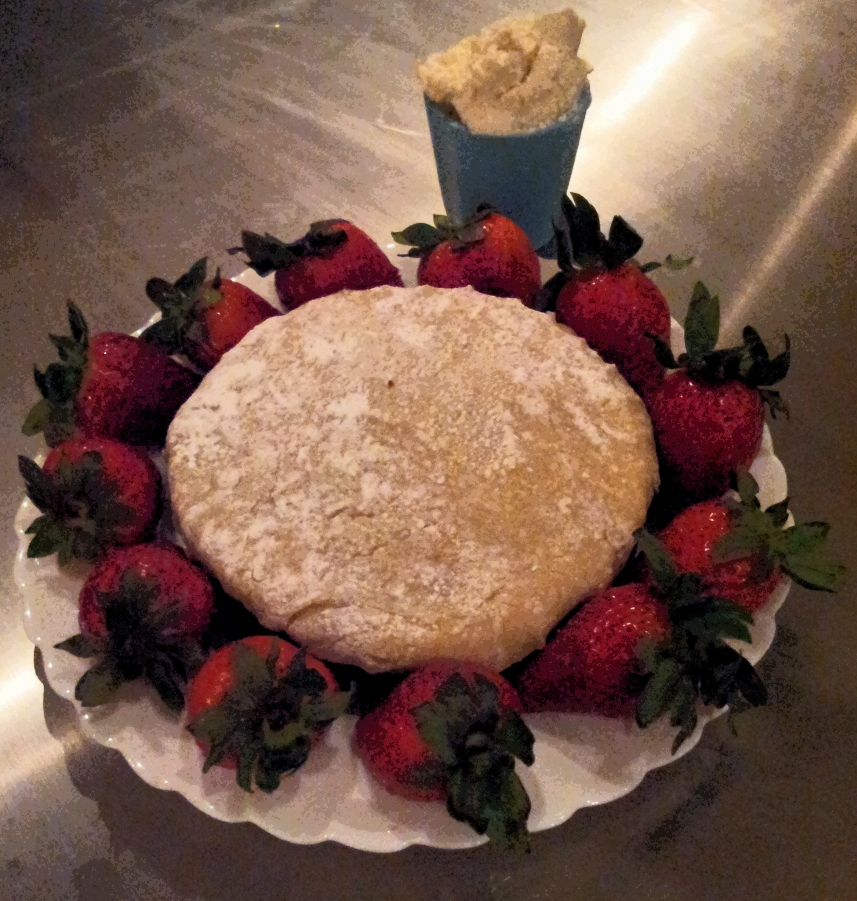
Easter Cake and StrawberriesEaster is a wonderful time, not just for the obvious reasons, the reassertions of rebirth and forgiveness, but its Spring after all, and the evenings are lighter and blossom has come out to give us all hope that fresh life brings.

My Easter is probably the same as everyone else's, chocolate, Roast Chicken on Sunday and cake, in all its different forms.

The Easter cake I normally bake is based on a Victorian cherry and almond cake, just topped off with a soft marzipan cover.  It's not a traditional Simnel cake, simply because it doesn't have orange zest or the eleven marzipan balls on top.  Also, because I still have lingering nightmares of marzipan from the 1970s and 1980s, the hard, firm and dry, bright yellow marzipan of my youth, the marzipan I top this cake with is my own concoction that is just firm enough to roll out.

This is a relatively low temperature baked cake which probably needs a little greaseproof "hat" for the first half an hour of cooking.  Before taking off the hat, turn the heat up by 10 degrees for a few minutes before, and then after a few more minutes once the oven has been closed again to turn it back down to its original setting.

Cake Ingredients:

  • 4 ozs (100 grams) of salted butter
  • 4 ozs (100 grams) of caster sugar
  • 2 medium eggs (thoroughly beaten)
  • a teaspoon of orange water
  • 4 ozs (100 grams) of glacier cherries
  • 4 ozs (100 grams) mixed dried fruits, pre-soaked in natural yogurt
  • 4 ozs (100 grams) ground almonds
  • 2 ozs (50 grams) self raising flour
  • half a teaspoon of baking powder
You will also need three dessert spoons of marmalade and the ingredients below for your marzipan. 
For this cake you will need a 7 inch (17.5 cms) baking tin, approximately one and half inches (4cm) deep.

Pre-heat your oven to 160 degrees centigrade (320 F), Gas mark 2

Cream together the butter and caster sugar until light.  Add the beaten eggs gradually.  If doing this by hand add a dessert spoon of the ground almonds at this point and it will help bind the eggs and butter mixture more evenly and easily.
Remember your orange waterAdd the orange water and fruit next until the mixture is well combined and only then add the remaining dry ingredients through a sieve.  This is includes the soaked dried fruit along with the yogurt you steeped them in.

Fill your tin and place in the oven on the middle shelf.

Remove the hat after 30 minutes and then continue baking for another 30 to 40 minutes.  Use a metal skewer at the 30 minute mark and if it comes out clean your cake is done.

Let your cake cool in it's tin for the first 30 minutes or so before turning it out to a cooling tray.


Meanwhile, as this is cooling its time to make your "soft marzipan".  Now remember this is my own preference, so if you like a more solid marzipan either use less liquid or add more ground almonds.

Soft marzipan ingredients
(makes about 8 ozs or 400 grams)

  • 3 quarter cups of caster sugar
  • 5 quarter cups of icing sugar
  • 8 quarter cups of ground almonds
  • 1 desert spoon orange water
  • 1 large egg (beaten well)
  • additional icing sugar for rolling out
Sift the dry ingredients together and add the orange water and egg to make a soft dough/paste.

Work the dough until it is smooth and then place in a bowl and cover and put in the fridge for at least an hour.

When rolling out this marzipan, be generous with your icing sugar, ensuring there is plenty on the work surface as the softness of this paste makes it stick readily.  Use a tea plate to make a round to place on the top of your cooled cake.  The disk of marzipan should be slightly larger than the width of the cake.
Easter cake with strawberries and almond creamPlace the marmalade in small non-stick pan over a low heat.  As it starts to become runny, just switch off the heat.  The consistency will remain just so for about ten to fifteen minutes will be perfect to brush onto the now cooled cake.  Place the disk of marzipan on top of this.  Then, using the end of the handle of a teaspoon, flatten the overlap of the marzipan against the edge of the cake to give a scalloped pattern.
I normally serve this with, as you can see, strawberries and almond cream.

Monday, 10 April 2017

The beauty of distraction; the Haiku

The beauty of distraction is just that, distraction. 

Battling anxiety, that knot in the stomach, the feeling of not being in control.  There seems to be an insurmountable need to focus on the something that isn't related to the task at hand.

Distraction is giving yourself the permission to have a break and disappear into another world. 

If you have a flair for words, perhaps taking fifteen or twenty minutes in your busy day to create a Haiku, could be your thing.

My attempt is below, with my rhubarb flowers as inspiration.

 
Jurassic, graceful
colour in emerald hues
beauty to be seen
 
 
How I understand it, the Haiku has 17 syllables in all and for English Haiku a 5, 7 and 5 split in each line.  In Japanese these are set out vertically and in the West, as above.  The traditional Haiku has a nature reference, the poem should have a break in the first or second line and is about a fleeting thought or observation.
 
 
As there are elements to be considered, for example no rhyming lines, imagery over statements and almost impressionist style, this can be a very effective distraction.
 
 
Rhubarb flowers


New Year, New Thoughts

Happy New Year everyone From this January I’m hopefully going to bring you more content on the delights of social eating and entertaining, ...